

Limassol, Cyprus
October 2026
Computer Engineering
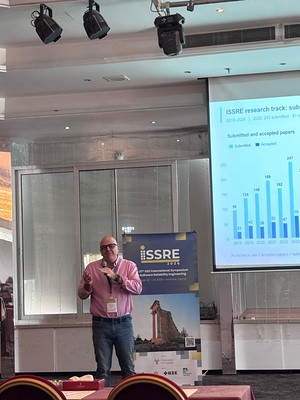
The 37th IEEE International Symposium on Software Reliability Engineering (ISSRE 2026) brought together 205 academics, researchers, students, and industry practitioners from 35 countries in Limassol, Cyprus, from October 20 to 23, 2026.
Held in person at the St Raphael Resort and Marina and hosted by the Department of Computer Science at the University of Cyprus, ISSRE 2026 was held under the auspices of the IEEE, the IEEE Reliability Society, and the IEEE Computer Society.
The conference took place in Limassol, a coastal city where modern business activity meets the character of the Mediterranean. October offered a pleasant setting for participants to explore the seafront, enjoy the city’s restaurants and historic neighbourhoods, and continue conversations beyond the conference sessions.
Programme
ISSRE 2026 addressed a broad range of topics shaping the future of software reliability engineering. Its conference tracks covered Foundations of Reliability and Dependability; Reliability in AI-Driven and Autonomic Systems; AI Techniques for Reliability Engineering; Software Reliability in Emerging System Domains; Trustworthiness, Security, and Responsible Software Engineering; and Human-Centered, Empirical, and Reproducible Reliability Research.
The programme featured three invited keynote presentations. Prof. Don Syme from GitHub presented The Agentic Repository Automation Revolution. Prof. Paolo Tonella from Università della Svizzera italiana (USI) delivered AI Testing: What Have We Learned? Where Are We Heading?. Prof. Laurie Williams from North Carolina State University (NCSU) presented Dependable Software, Untrusted Parts: Security Research for the Software Supply Chain.
These keynote sessions complemented the research programme by bringing attention to current developments in agentic automation, AI testing, and software supply chain security.
Awards and research recognition
The closing ceremony recognised outstanding contributions to software reliability engineering through the presentation of paper, artifact, and reviewer awards.
The Test of Time Award went to Shilin He, Jieming Zhu, Pinjia He, and Michael R. Lyu for Experience Report: System Log Analysis for Anomaly Detection. The Test of Time Runner-Up Award was presented to Carla Sauvanaud, Kahina Lazri, Mohamed Kaâniche, and Karama Kanoun for Anomaly Detection and Root Cause Localization in Virtual Network Functions.
The Research Track Distinguished Paper Awards recognised the following contributions:
- Arastoo Zibaeirad and Marco Vieira, for Calibration Without Comprehension: Diagnosing the Limits of Fine-Tuning LLMs for Vulnerability Detection in Systems Software.
- Loic Robert, Vincent Nicomette, Eric Lacombe, Marie-José Huguet, and Emmanuel Hebrard, for ProvScope: A Tool to Assist Cybersecurity Analysts in Identifying Information Flows in Complex Systems.
- Kazuki Takeda and Hiroshi Yamada, for Resilient Page Table Management under ECC-uncorrectable Memory Errors.
- Mengdi Qin and Bo Jiang, for RotDroid: Cross-Orientation State Equivalence Testing for Detecting GUI Rotation Bugs in Android Apps.
- Niful Islam, Ragib Shahriar Ayon, Deepak George Thomas, Shibbir Ahmed, and Mohammad Wardat, for When Agents Fail: A Comprehensive Study of Bugs in LLM Agents with Automated Labeling.
The RENE Track Distinguished Paper Award was presented to Hang Cui, Cenjie Hu, Changhua Pei, Juncheng Hu, Haotian Si, Zihan Liu, Ke Xiang, Yuxuan Li, Quan Zhou, Xiaohui Nie, Zexin Wang, Jingjing Li, Dan Pei, and Gaogang Xie for From Benchmark Accuracy to Diagnostic Boundaries: A Time-Aware Replication of DEST.
The Industry Track Distinguished Paper Awards recognised three contributions:
- Bhala Ranganathan and Minghua Ma, for Bridging the Mitigation Gap: A Taxonomy-Driven Empirical Study of Incident Recovery in Production LLM Serving.
- Prakash Kl, Anton Korenkov, Uttam Thakore, and Christopher Hegre, for Making Deployments Safe at Meta: Health Checks for Continuous Change-Safety.
- Tobias Philipp, for The Prover Is the Judge: Verified Security Software from AI Coding Agents in Ada/SPARK.
The Best Artifact Award went to Robin Thunig, Christoph Borchert, Urs Kober, and Horst Schirmeier for SIEVE: Hybrid Hardware/Software Detection of Multi-Bit Errors in Random-Access Memory.
The symposium also recognised the work of its peer reviewers. The Industry Track Distinguished Reviewers Awards were presented to Fabrizio Pastore, Muslim Chochlov, Uttam Thakore, and Zhuangbin Chen. The Research Track Distinguished Reviewers Awards recognised Shenglin Zhang, Andrea Bombarda, Raffaele Della Corte, Drishti Yadav, Yintong Huo, Giovanni Quattrocchi, Diego Clerissi, Zitao Chen, Jingzhi Gong, Wenwei Gu, and Yintong Huo.
The welcome reception took place in the lobby of the St Raphael Resort and Marina, where attendees enjoyed canapés and local drinks while overlooking the Mediterranean Sea. The conference dinner took place at Agios Epiktitos Tavern in scenic Armenochori Village. Participants enjoyed traditional Cypriot food, drinks, and music, with dancing adding to the evening’s atmosphere. The dinner offered a chance to experience local hospitality and share time with colleagues outside the formal conference programme.
Acknowledgments and Next Location
Prof. Leonardo Mariani and Prof. George Papadopoulos served as Conference General Chairs, overseeing the event and helping ensure its smooth operation. The organising committee included Roberto Natella as Program Coordinator; Domenico Cotroneo and Jie M. Zhang as Research Program Committee Chairs; Sigrid Eldh and Jinyang Liu as Industry Program Chairs; Junjie Chen, Georgia Kapitsaki, and August Shi as Workshop Chairs; Lili Wei and Stefan Winter as Doctoral Symposium Chairs; Yintong Huo and Luigi Lavazza as Fast Abstract and Project Highlights Chairs; Hélène Waeselynck as J1C2 Chair; Artur Andrzejak and Li Li as Replications and Negative Results Chairs; José D’Abruzzo Pereira and Allison K. Sullivan as Publicity Chairs; Sherlock Licorish and Maria Teresa Rossi as Publication Chairs; Naghmeh Ivaki and Fumio Machida as Artifact Evaluation Chairs; Costas Pattichis as Financial Chair; Eleni Constantinou as Diversity and Inclusion Chair; and Michalis Ioannides and Elena Masserini as Web Chairs. EasyConferences Ltd supported local arrangements, registration, and visa services.
The Conference Chairs thanked everyone who contributed to the success of the symposium. “We thank all authors, speakers, reviewers, committee members, and participants for making ISSRE 2026 a valuable meeting for the software reliability engineering community. The exchange of ideas between researchers and practitioners remains essential to advancing dependable software, addressing emerging technological challenges, and turning research findings into practical improvements. We are grateful to everyone who helped make this year’s conference a success.”
The host organiser, the Department of Computer Science at the University of Cyprus, supports education and research across computer science and related areas. The IEEE is a global professional organisation advancing technology for the benefit of humanity. The IEEE Reliability Society promotes the engineering and management of reliability, while the IEEE Computer Society supports the advancement of computing and computer science through professional activities, publications, and technical communities.
The conference was supported by EasyConferences, which provided its Online Registration System (easyconferences.eu/online-registration) and Conference Coordination Services (easyconferences.eu/conference-management).
ISSRE 2027 will take place in Taipa, Macao SAR China, offering the software reliability engineering community another opportunity to share research, build professional connections, and discuss the future of dependable software systems. October generally brings more comfortable conditions for exploring Taipa’s historic village streets, local food culture, and waterfront areas between sessions, allowing participants to experience a different side of Macao while attending the symposium. The next edition will continue the ISSRE tradition of bringing together researchers and practitioners to advance software reliability engineering through research, collaboration, and the exchange of practical experience.